
Case study
Télé 7 JoursFour months to take it all over
At the end of 2025, Bauer Media France entrusted us with the Télé 7 Jours website and apps. By May 2026, everything was running on a brand-new foundation, written by our teams.
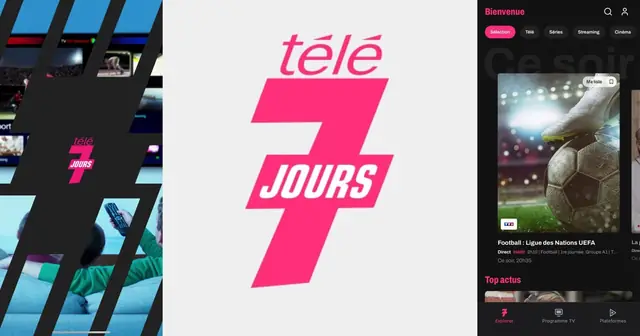
01. The context
By acquiring Télé 7 Jours at the end of 2025, Bauer Media France also took over a website, programme-television.org, and two apps, on iOS and Android. Every month, several million people open them to find out what's on tonight. They had to be taken over quickly, without those readers noticing.
Bauer did not choose us by chance. TV listings have been one of ArtWhere's core specialities since 2008: that year, we launched the Ciné-Télé Revue website. In 2018 came Télé Câble Sat, which we continued to develop and host when the title joined Bauer. In 2022, Maximag, which we built and have been running ever since. Télé 7 Jours was the logical next step. It was also, by far, the biggest job.
02. TV listings, the real heart of the project
Télé 7 Jours is first and foremost a reflex: you open the app to find out what's on tonight. The news, the celebrities, the series — everything else revolves around that question.
Behind it lies machinery few people suspect. Thousands of broadcasts a day, on dozens of channels, constantly shifting: a match that runs over, a programme pulled from the schedule, a film replaced at the last minute. The schedule has to be accurate at the moment the reader looks at it, not the day before.
Every programme has its own page: the film, the series with its seasons and episodes, the documentary, the cartoon, the sports broadcast. These pages are linked to channels, time slots and the newsroom's articles. On the website, that adds up to hundreds of thousands of pages, and a large share of the audience coming from Google enters through them.
That was the system we had to take over without breaking anything. A badly migrated article is embarrassing. A wrong schedule on a prime-time evening, and readers notice straight away. And this is a trade we have been practising for eighteen years.
03. Why rewrite everything
The old website worked. We could have moved it as it was. We chose not to, for two reasons.
The first has to do with the group. Bauer Media France already has several titles with us, all on the same technologies. Putting Télé 7 Jours on a different stack would have created an island of its own, with its own tools and its own habits. By rebuilding it on the same foundation as the other websites, the titles can share code, features and know-how. An improvement made for Maximag can serve Télé 7 Jours the next day, and vice versa.
The second has to do with infrastructure. The old platform relied on a patchwork of managed cloud services. It works, but when something goes wrong, you have to wait for someone else to understand and fix it, and the bill moves with usage. We went back to servers we administer ourselves. If a final sends the audience through the roof one evening, or a problem crops up at 11 pm, our teams can act immediately. And Bauer knows the cost in advance.
All of this had to fit into four months, with two non-negotiable rules. Readers had to find their Télé 7 Jours exactly as before. And Google was not to lose any of the hundreds of thousands of pages already indexed.
04. What we did
We started with a full audit: every page, every user journey, every URL, every ad slot. On a migration of this size, whatever gets forgotten always ends up resurfacing in production.
The website was rebuilt on WordPress. We took over and migrated all the editorial content and programme data. The editorial teams now work in a tool they know well, on an architecture sized for traffic peaks.
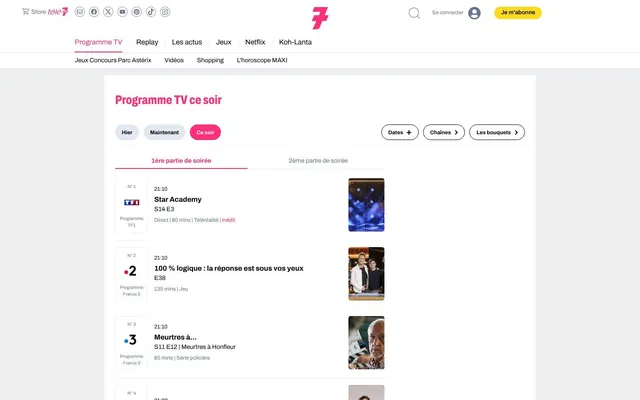
The listings engine was rebuilt at the same time. Import and continuous updating of data, schedules by channel and by evening, programme pages with seasons and episodes, links to the newsroom's content: everything was rethought, and both the website and the apps draw on the same data. The evening schedule now shows the 26 main channels at a glance, whereas the old website displayed only 16 by default.
The iOS and Android apps were rewritten from scratch in React Native. A single codebase serves both platforms: updates ship faster, and bugs that exist on only one side have become rare.
For the design, we deliberately reproduced the existing look as closely as possible. Readers hadn't asked for anything. On switchover day, they had to open the app and find everything in its usual place.
The redirect plan, sitemaps and canonical tags were prepared well before go-live. It's work nobody sees, but it is what decides whether the audience follows.
Finally, development, testing and production are now separated on our infrastructure. Nothing reaches readers without first going through a test environment.
05. The switchover
The Android app was released in early May 2026. On 12 May, the iOS app and the website moved over to the new platform in turn. That same evening, the website had absorbed several million visits without a hitch. For a first day, we hadn't dared hope for that.
GDPR consent management has been built into the apps from the design stage.
06. Today
Hosting and maintenance
Hosting and maintenance of the website and both apps
Daily stability monitoring
Daily stability of the apps and the website
Updates
Preparing in advance for the changes Apple and Google impose with each new version of their systems.
DEADLINES AND BUDGET: MET.
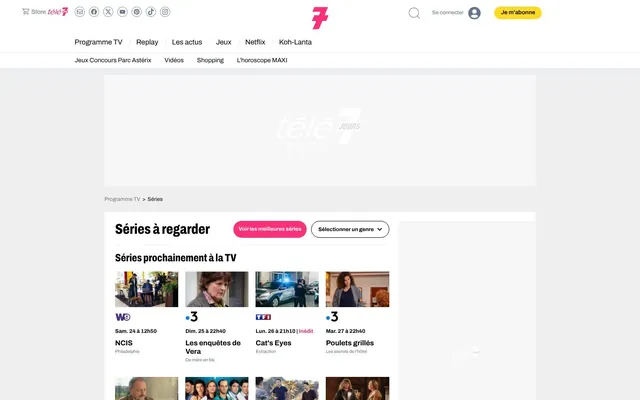
The site in pictures

Get in touch
ArtWhere, digital innovation